

 Nicole Johnson
September is Sepsis Awareness month, so there is no better time to bring up this controversial, yet old habit, common to the nursing profession. Did you know that many nurses do not count their patient’s respirations? You are probably not surprised. Are you 16 RR per minute or an 18 RR/min kind of nurse when assessing your patient? Guilty as charged? All jokes aside, I’m hoping to persuade you to count your patient’s RR.
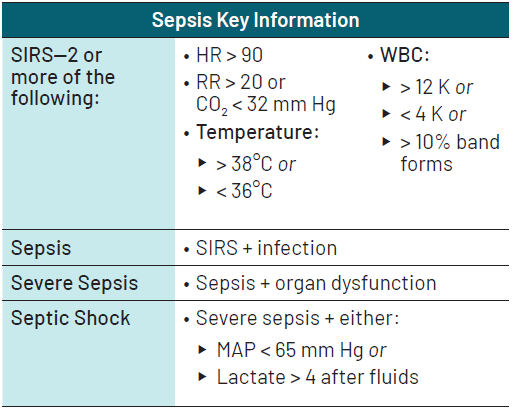
The reason you should care about getting an accurate respiration rate per minute is because an increased RR is an early warning sign of sepsis. According to the SIRS criteria, a RR of > 20 is an early warning sign. The respiratory rate is the most sensitive and specific to patient deterioration. It’s not that high, you might think to yourself, however it is sepsis physiology that is causing an increased RR. The normal RR of a patient is 12-18 RR per minute. When a patient is experiencing sepsis physiology, they start to increase their respirations. The lungs are trying to breathe off CO2, compensating for a metabolic acidosis or a decrease in HCO3+. They are training to balance their pH!
So, an increased RR is something to pay attention to! Does it mean your patient has sepsis? No, but look at the other SIRS criteria found in the Critical Care Survival Guide to help inform what is happening. You may need to pay attention to the other signs and symptoms of sepsis.
Want to learn more about the sepsis, septic shock, and the sepsis bundle? Check out Nicole’s Surviving Sepsis: Every Second Counts! – On sale now!
Be empowered to help save your patient’s life by doing a more accurate respiratory assessment!
Now, go count that respiratory rate!
https://emedicine.medscape.com/article/168943-overview
https://emedicine.medscape.com/article/2172054-overview
https://reference.medscape.com/calculator/522/sirs-criteria-systemic-inflammatory-response-syndrome





Add comment