

 Claire Goza
Central line–associated bloodstream infections (CLABSIs) are among the most dangerous hospital-acquired infections in healthcare. Despite ongoing prevention efforts, they continue to pose a significant threat to patient safety. But what if a key contributor has been hiding in plain sight?
A new peer review published in the Journal of Infectiology & Epidemiology explores the fascinating connection between stethoscope hygiene and the potential elimination of CLABSI. Co-authored by W. Frank Peacock, Kathleen Vollman, Cynthia Cadwell and Nicole Kupchik, “Eliminating CLABSI: Is stethoscope hygiene the missing piece?” helps to answer the question of what role a nurse’s “third hand” really plays in the spread of bacteria that cause this life-threatening condition.
The Overlooked “Third Hand”
The stethoscope is used on nearly every patient, every day, but unlike hand hygiene, stethoscope cleaning is often inconsistent and unregulated.
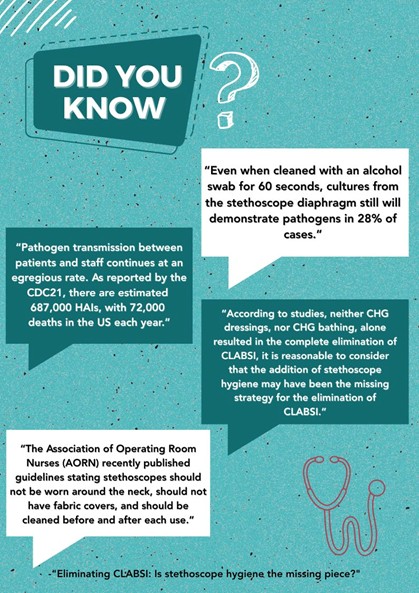
Even when clinicians follow guidelines and clean the diaphragm with alcohol for 60 seconds, research shows that 28% of stethoscopes still harbor pathogens (including those responsible for bloodstream infections).
Despite this, the CDC still classifies stethoscopes as “non-critical” surfaces. That means they should be washed but there is not an enforced frequency.
A Simple Solution Fix That Worked
A recent ICU project implemented a two-part solution:
- Touch-free, single-use stethoscope diaphragm barriers
- Chlorhexidine gluconate (CHG) dressings for central lines
That outcome was 0 CLABSI cases for over 12 consecutive months.
Key Takeaways
Take a look at some surprising facts below and learn more by exploring the full article here: Eliminating CLABSI: Is stethoscope hygiene the missing piece?
Final Thought
Hand hygiene wasn’t always standard practice. It became one when we realized how easily infections spread. Stethoscope hygiene could be the missing step in moving forward.
With evidence mounting, maybe it’s time to start listening more carefully to what our stethoscopes are telling us.



 Nicole Johnson

Add comment