

 Claire Goza
Have you already tackled the CCRN® or PCCN® exam and became certified? If you’re a critical or progressive care nurse looking to deepen your expertise and stand out in your field, the CMC® and CSC® certifications could be your next big move. These subspecialty credentials highlight your advanced knowledge in cardiac care and can open doors to new professional opportunities.
Here’s how you can begin the next endeavor in your certification journey.
What exactly are the CMC® and CSC® Certifications?
The Cardiac Medicine Certification (CMC®)and Cardiac Surgery Certification (CSC®) are subspecialty certifications for nurses who have already passed the CCRN® or PCCN® exam. These certifications are a way for nurses to demonstrate their expert knowledge when caring for cardiac medicine and cardiac surgery patients, respectively.
Both exams are 90 questions and last two hours. The CMC® exam covers cardiovascular and non-cardiovascular conditions while the CSC® exam covers cardiac procedures and complications. They both cover therapeutic interventions and monitoring and diagnostics.
Why do nurses choose to get CMC® / CSC® certified?
Nurses choose to get CMC® or CSC® certified for many of the same reasons they started their certification journey. These certifications validate nurses’ advanced knowledge in caring for cardiac patients. They may result in career advancement by giving opportunities for promotion or access to more specialized roles. Overall, they show clinical excellence!
CMC® versus CSC® Exam: What is the difference?
Which certification exam to take is completely up to each individual nurse and what would best serve them in their career. It depends on the patients they care for regularly. There are key content differences between each exam.
Who should take the CMC® Exam?
The CMC® exam covers care given to acutely/critically ill adult cardiac medicine patients. It is geared towards certified nurses, currently practicing in areas such as CCU, combined ICU/CCU, medical ICU, telemetry, progressive care, heart failure clinics/home care, interventional cardiology, cardiac catheterization labs, and/or electrophysiology units.
Who should take the CSC® exam?
The CSC® exam covers care provided to acutely/critically ill adult cardiac surgery patients. It is geared toward certified nurses, currently working in areas such as cardiovascular surgery, cardiothoracic surgery, or post-anesthesia care units, caring for cardiac surgery patients in the first 48 hours postoperatively.
What are the requirements for taking each exam?
To be eligible to sit for the CMC® or CSC® exam, you must:
- Have a current, unencumbered RN or APRN license in the U.S. or current, nationally accredited (ABSNC or NCCA) clinical nursing specialty certification.
- Practice as an RN or APRN for 1,750 hours in direct care of acutely/critically ill adult patients during the previous two years, with 875 of those hours accrued in the most recent year preceding application. Of those 1,750 hours, 875 must be in the care of acutely/critically ill adult cardiac patients for CMC, or acutely/critically ill adult cardiac surgery patients within the first 48 hours postoperatively for CSC.
- OR Practice as an RN or APRN for at least five years with a minimum of 2,000 hours in the direct care of acutely/critically ill adult patients, with 144 of those hours accrued in the most recent year preceding application. Of those 2,000 hours, 1,000 must be in the direct care of acutely/critically ill adult cardiac patients for CMC, or acutely/critically ill adult cardiac surgery patients within the first 48 hours postoperatively for CSC
- You may apply online or via paper application for certification exams on AACN’s website.
- Pay the exam fee: $145 for AACN members and $235 for nonmembers
How long does each certification last?
Once you pass the CMC® / CSC® Exam, you are certified for three years. After that, you can either:
- Recertify by obtaining the required continuing education and practice hour requirements
- Retake the exam
How can nurses prepare for the CMC® / CSC® Exams?
Studying for the CMC® or CSC® exams can feel intimidating at first, but with the study plan, any nurse can feel confident on exam day.
Consider making a review course a part of your study plan. Nicole Kupchik Consulting offers online, on-demand review courses for both the CMC® and CSC® exams. These self-paced courses, which are part of ACCN’s test plans, include video lectures and downloadable study guides. Plus, you’ll receive CE credits upon completion.
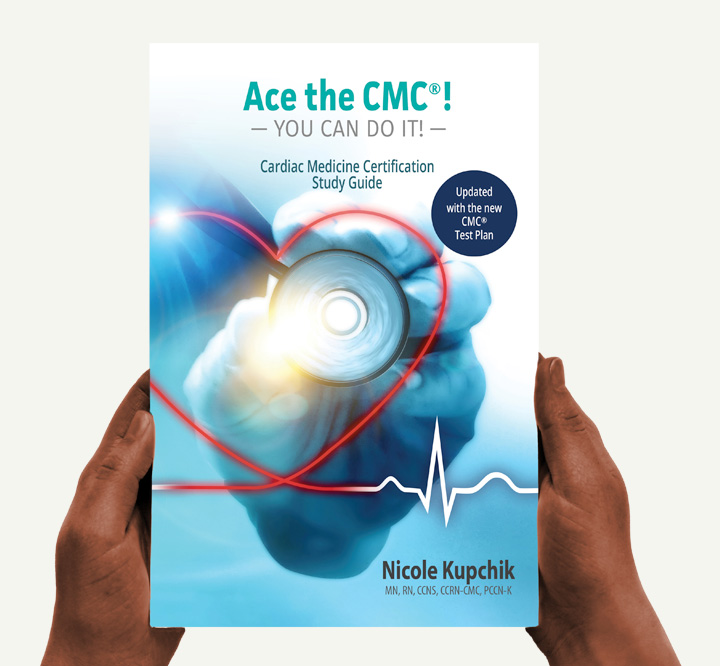
Practice exams are another one of the best ways to test your knowledge and see what your strongest and weakest areas are ahead of the exam. Check out Nicole Kupchik Consulting’s Ace the CMC® or Ace the CSC®Study Guide Books! Both books are amazing resources for prepping for your exam and contain full practice exams that provide the rationale for each of the questions.

Where can nurses take the exam?
CMC® and CSC® exams are offered via computer at hundreds of testing centers across the United States, and each exam takes about 2 hours to complete.
What should I expect on exam day?
Plan to arrive at your testing center early! You will not be admitted if you arrive more than 15 minutes past your scheduled time.
Make sure you bring a government-issued ID to the exam center. It is required to sit for the exam.
Acceptable forms of ID include:
- Driver’s License
- State / Province ID Card
- International Travel Passport
- U.S. Visa
Just make sure that the name on the ID that you present is the same as the name on your AACN record.
After you complete your exam, your results will appear on-screen immediately. You will receive a more in-depth score report within 24 to 48 hours post-exam completion.
What happens if you fail the exam?
Failing the exam, although disappointing, is not the end of the world! You can retest up to 4 times in the following 12-month period. Remember to take advantage of your score report so you can see what you need to focus on for the next time you test. You can send your score report to us anytime at [email protected] for feedback on what to focus on before you retest.
Getting ready for these nursing certifications might seem overwhelming at first, but the payoff can be a powerful boost to your career in cardiac care. With the right plan and tools to support you, YOU can do it!



 Nicole Johnson
Add comment