

 Nicole Johnson
So, it is the middle of the night, and you are new to the ICU and haven’t had a chance to do your ACLS course. If your patient does code, how do you know which rhythms to shock or not? It can feel daunting not to know this information. Don’t worry, I’ve got you, bestie. This is a great question. Let’s start by spelling out the rhythms we do shock or defibrillate, so this simplifies things.
Here are the rhythms we defibrillate:
Ventricular Fibrillation (VF)
What is it?
In VF, the heart is quivering without organization. This is a fatal arrhythmia, and the key is early defibrillation. In this scenario, you would call a code, start CPR, attach the defibrillator pads, and get the defibrillator ready for early defibrillation. Typically, you will defibrillate with 120 – 200 joules on a biphasic defibrillator, but follow the manufacturer’s guidelines. For the second shock, increase the joules. You can defibrillate every 2 minutes. Your 1st line drug is 1 mg epinephrine. An antiarrhythmic, such as 300 mg amiodarone, may be given if the rhythm isn’t responsive to electricity. Follow the ACLS guidelines!

Ventricular Tachycardia (VT) Without a Pulse
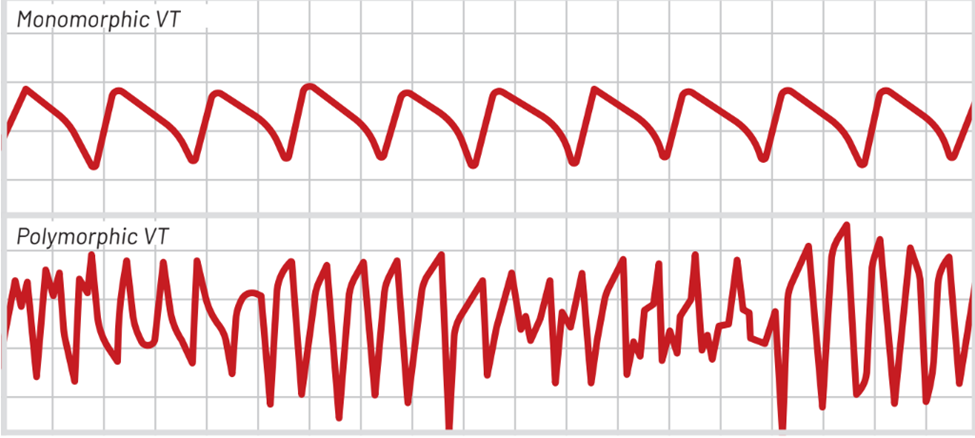
What is it? In VT, the lower chambers of the heart are beating too fast to provide adequate blood flow. It can be monomorphic or polymorphic in nature. This is also a fatal arrhythmia, and the key is early defibrillation. In this scenario, you would call a code, start CPR, attach the pads, and get the defibrillator ready for early defibrillation. Typically, you will defibrillate with 120 – 200 joules on a biphasic defibrillator, but follow the manufacturer’s guidelines. For the second shock, increase the joules. You can defibrillate every 2 minutes. The 1st line drug is 1 mg epinephrine. An antiarrhythmic, such as 300 mg of amiodarone, may be given if the rhythm isn’t responsive to electricity. Follow the ACLS guidelines!
Torsades de Pointes (TdP)
What is it? In TdP, the lower chambers of the heart are beating too fast to provide adequate blood flow. It is polymorphic in nature and can deteriorate into VF. TdP is associated with long QTc intervals. When pulseless, the key is early defibrillation. In this scenario, you would call a code, start CPR, attach the pads, and get the defibrillator ready for early defibrillation. Typically, you will defibrillate with 120 – 200 joules on a biphasic defibrillator, but follow the manufacturer’s guidelines. For the second shock, increase joules. The 2nd priority would be administering a 2 mg Magnesium slow IV push. Follow the ACLS guidelines!

Asystole/PEA – Rhythms we do NOT defibrillate:
As far as the other rhythms in an arrest scenario, if there is no pulse present, it is either asystole or pulseless electrical activity (PEA). PEA can look like an organized rhythm, such as normal sinus rhythm on the monitor, but if there is no pulse detected with a rhythm on the monitor, it is PEA. Reminder: We do not shock PEA or asystole.

If you want more information on cardiac rhythms, please check out Nicole’s on-demand course 12 Lead ECG Interpretation: An Easy Approach. If you want to grow your cardiac knowledge, Nicole’s on-demand course, Cardiac Bootcamp, is just for you! Earn CEs, develop your skills, and grasp all things cardiac!

Additionally, if you are looking for a helpful guide to Critical Care Nursing, peek at Nicole’s Critical Care Survival Guide, now also available in digital download.
References:


Add comment